
Santiago Insignares Martínez, from Colombia and currently based in Berlin, Germany, uses playfulness and what he identifies as "the toy" to point to some of the heavier, contradictory corners of contemporary life. He leans into a vibrant, candy-colored palette and whimsical forms, tricking the eye with humor, irony, and a bit of playground angst to build sculptures that are sweet, sinister, and a little grotesque all at once.
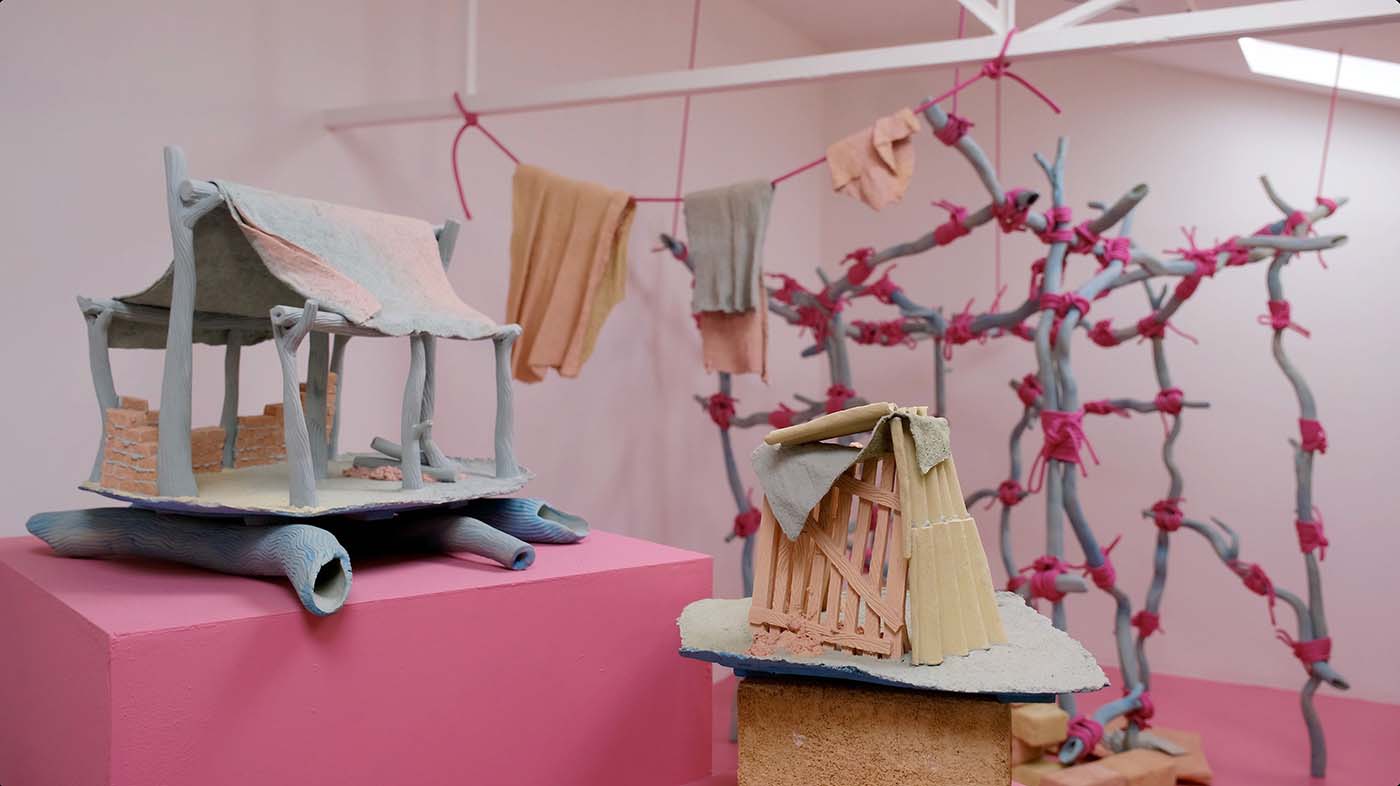
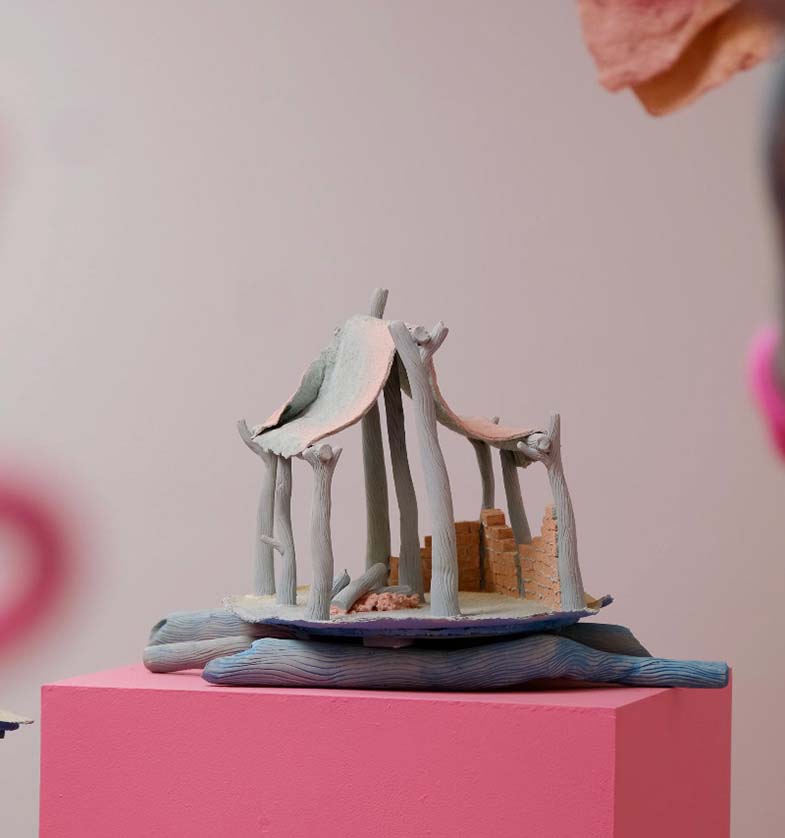
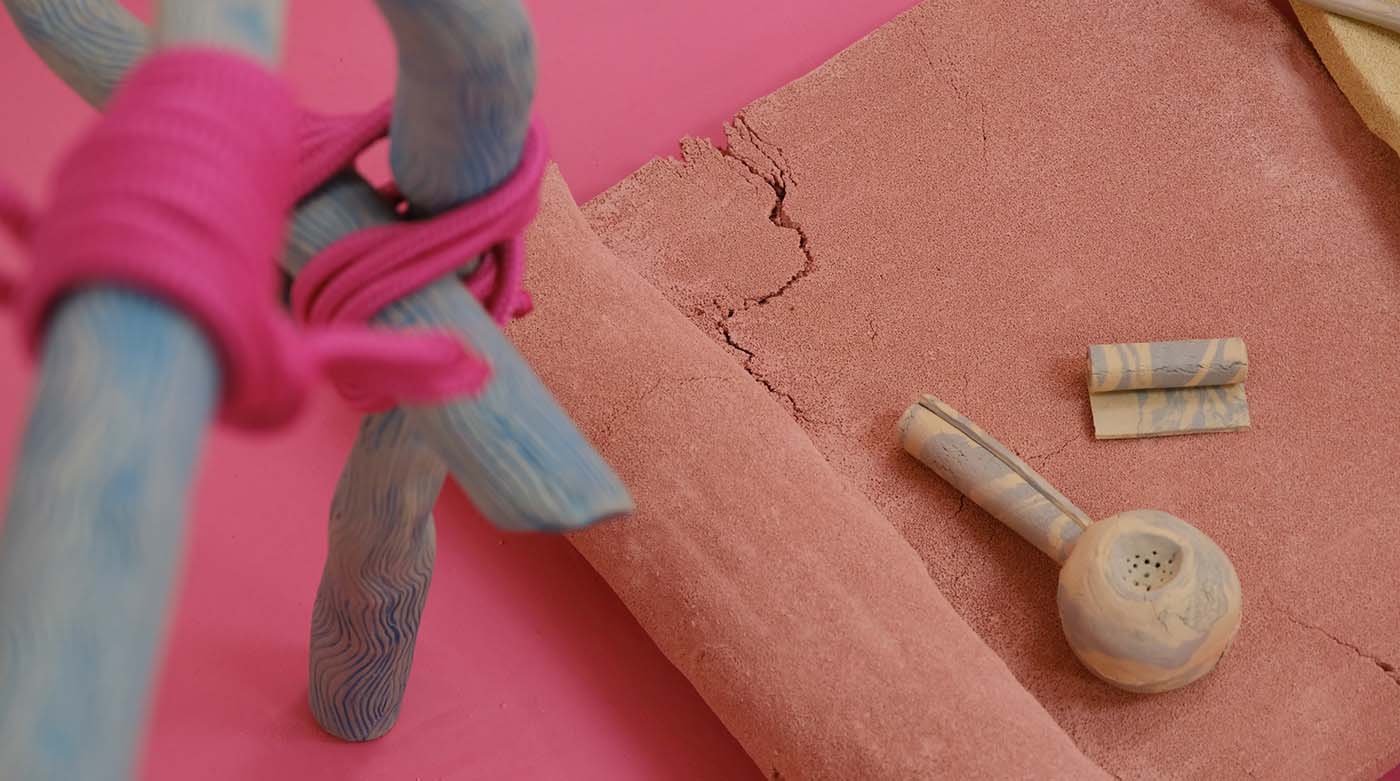
Insignares' history with clay goes back to 2013 during his studies at the San Francisco Art Institute, where he first used the material to make molds and cast replicas. Since then, his approach to sculpture and installation has been to use multiple components that are assembled into one piece. It wasn't, however, until attending the Fine Arts and Ceramic program at the Muthesius Kunsthochschule in Germany that he found a way to translate his additive method into ceramics. He ditched sketches and blueprints entirely, choosing to work in a totally spontaneous way. Instead of building finished, precious objects, Insignares now makes dozens of small building blocks—miniature bricks, columns, and slabs—which he binds on the fly with colored slip. It is a process that feels less like a traditional ceramic studio and more like a kid with a box of Legos, driven by a raw instinct to just build for the pure fun of it.
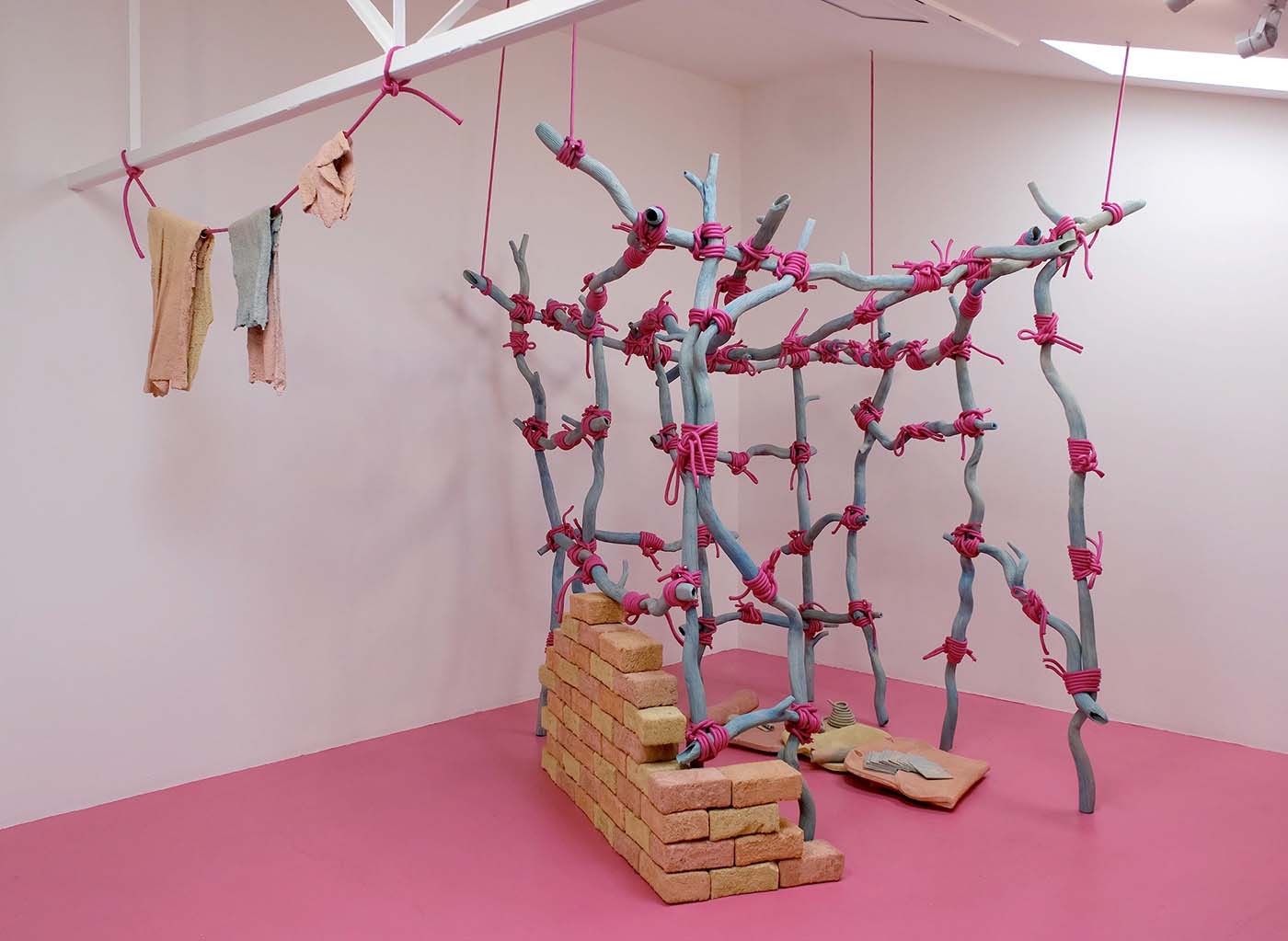
Lately, these building games have scaled way up. As seen in his latest exhibition, PALACIO, Insignares has turned the gallery into a full-scale, interactive landscape. To achieve this without losing his signature spontaneity, he started dipping everyday poly-foam and synthetic fibers into porcelain slip, firing them alongside extruded and hand-modeled parts. This technical experiment turns ordinary soft objects into "fragile fossils"—transforming clay into sagging blankets hung out to dry, makeshift corrugated roofs, and interlocking branches bound together by bright, hand-tied ropes. This exploration of materials and joining methods grants him total physical freedom at the moment of assembly, translating his building method from the miniature to site-specific installations. Because everything is built directly into the space, no installation can ever be configured the same way twice.
Thematically, the work deepens into the architecture of precarious, self-constructed shelters. Insignares is fascinated by the commonalities between a childhood fort built from cushions, blankets, and sticks—a refuge from the adult world—and the basic materials used to improvise a cambuche (shack) in an alley, under a bridge, or by the roadside. While both spaces are born from similar building gestures, their symbolic connotations are diametrically opposed: one evokes the nostalgia of a protected childhood, while the other carries the mark of the abject and the marginal, hidden from the hostile environment and the gaze of passersby. Yet, this stark contrast does not deprive them of an aesthetic simplicity that brings us closer to a primordial instinct of building. The resulting hybrid structures beautifully blur the boundaries between the playful and the precarious.
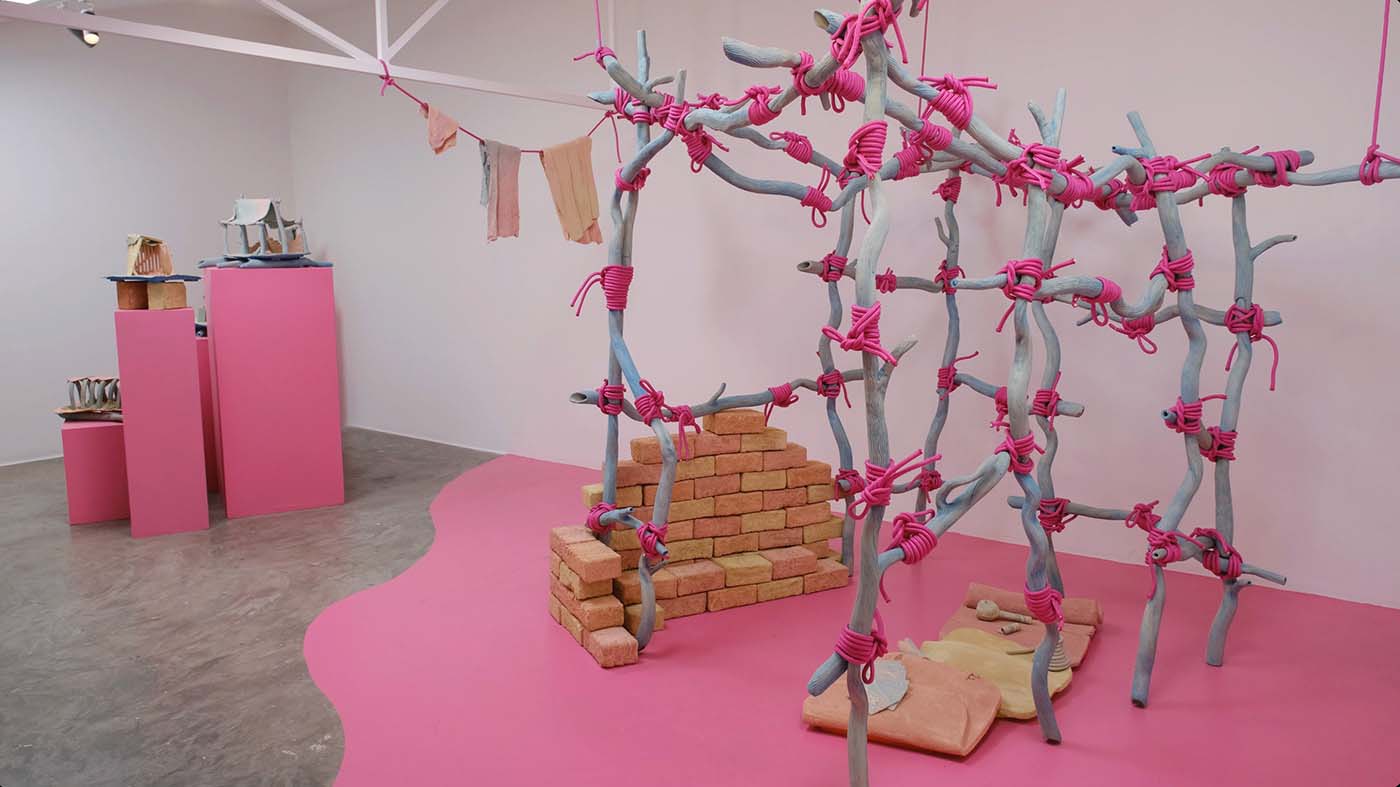
Insignares' critical approach to architecture and memory has led to his work being featured in the 12th Gyeonggi International Ceramic Biennale 2024 in South Korea, and selected as one of the ten Laureates of the Ceramic Brussels Art Prize 2026. Currently, his work is part of the permanent collection of the Gyeonggi Museum of Contemporary Ceramic Art. His solo exhibition PALACIO was on display at SGR Galería in Bogotá, and he will participate in a three-month residency program at the Longquan Wangou Art Center in China in October, which will culminate in a museum exhibition.
IN THE STUDIO WITH Santiago Insignares Martínez
Colombian artist Santiago Insignares Martínez builds like a kid with a box of Legos. He turns clay into miniature bricks, columns, and slabs, binding them on the fly into sculptures that are candy-colored, playful, and unsettling all at once. In this video, we step into PALACIO, his exhibition at SGR Galería, to explore his process of spontaneous, additive building and the ideas that shape it: the kinship between a childhood blanket fort and a decrepit cambuche, or shack, and the primordial instinct to build shelter, real or imagined, out of whatever is at hand.
Visit Santiago Insignares Martínez's websiteto learn more about the artist.