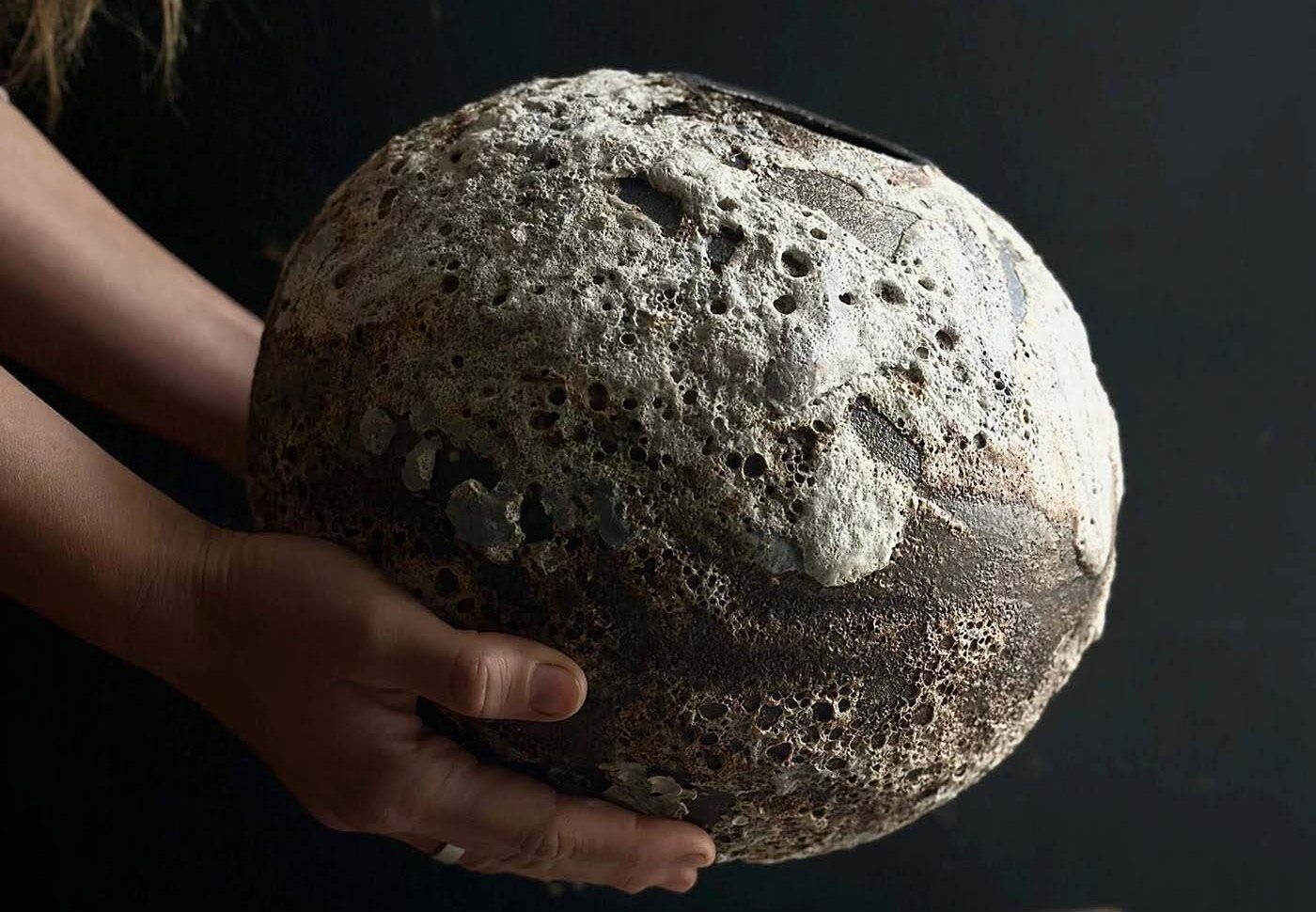
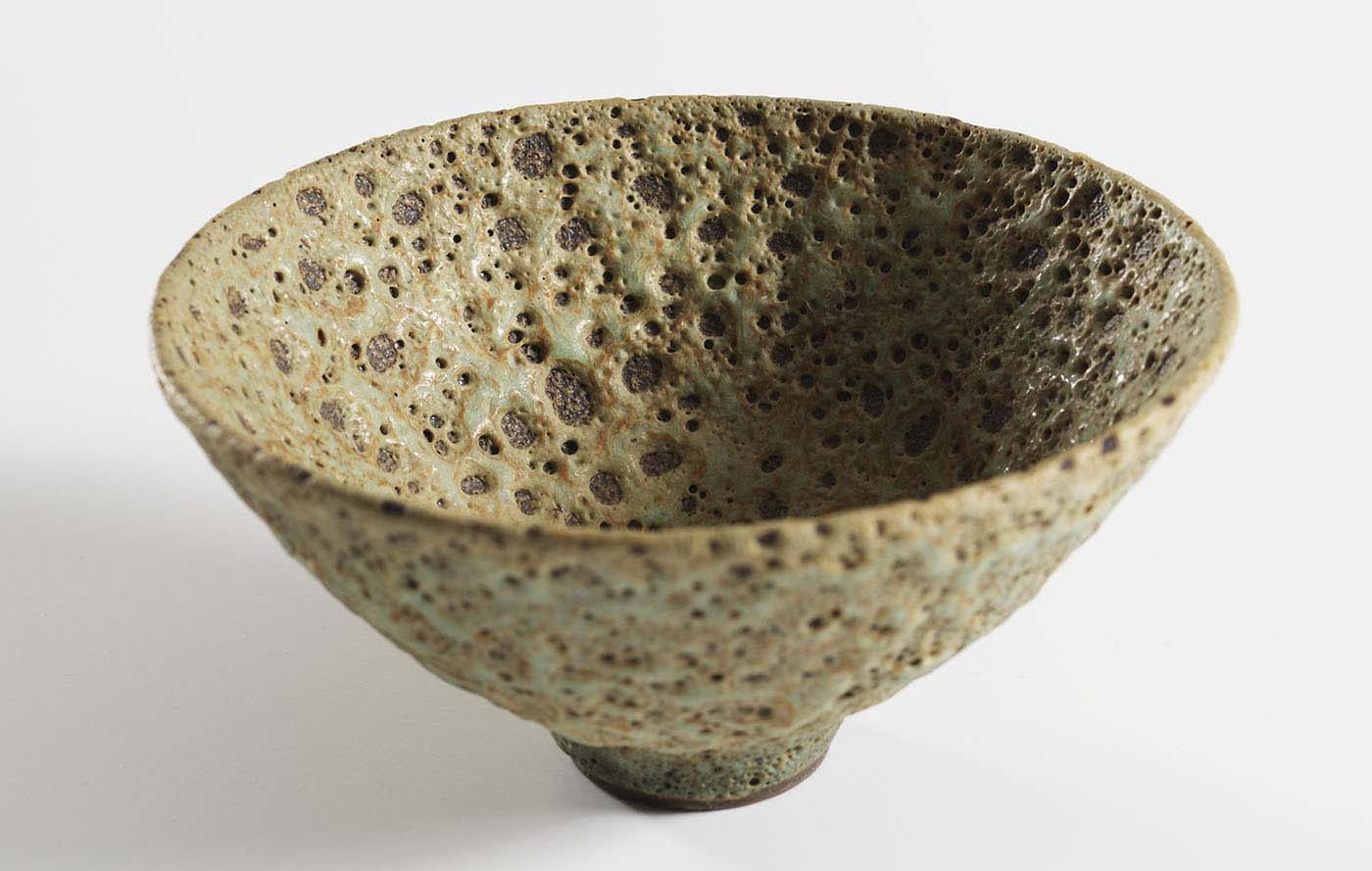
The first time I saw what’s called a lava or crater glaze, I didn’t even know what it was. The attractive and unique surface covered a cup I bought from a local ceramics shop. Its surface reminded me of the moon, and the cup became part of the first fancy handmade ceramic set I’d ever owned, which eventually jump-started my own ceramic journey. Once I started working with clay, I looked at that cup differently: I wanted to understand what made the surface possible.
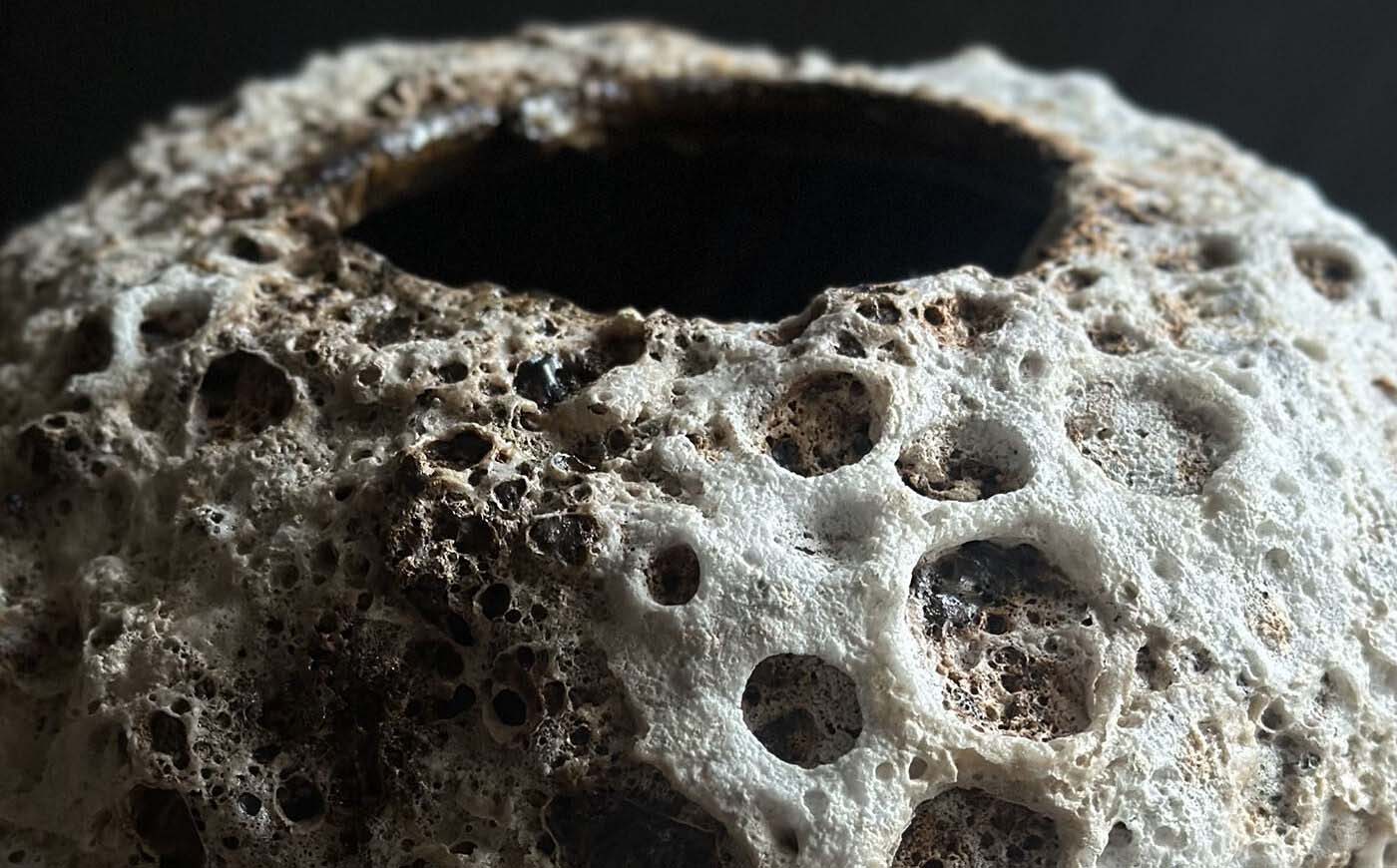
I tried a commercial lava glaze first, but it didn’t work at all. Fired in reduction, it came out flat, yellow, and completely non-bubbly. I went back to the shop and asked how they made theirs, only to be told it was a secret recipe. So I began learning to mix glazes and ran around twenty tests. None worked. While I was taking a class with Ceramic Materials Workshop, my teacher, Matt Katz, suggested that one of my materials might be wrong. He noted that silicon carbide, the key ingredient for the bubbles, should be black. Mine was white. As I discovered later, the supplier had mistakenly sent me 325-mesh silica.
Once I had the right material, the glaze finally began to move, literally and figuratively. But by then the interesting question was no longer simply: how do I make a lava glaze? It became: why does this happen, and how much of that behavior can I understand and control?
While my testing process is very systematic, in my finished work I often do the opposite. I layer and combine many different glazes, letting them react in ways I cannot fully predict. In a way, I create order through experimentation only to return to chaos in the final piece. This is what makes these geological, volatile, expansive surfaces possible. We so often make three-dimensional ceramic forms and cover them with two-dimensional finishes. I prefer a surface that has its own volume — one that grows, puffs, cracks, crawls, and records what happened inside the kiln.
Texture slows the object down and brings us back to nature, to something primal and often forgotten. People often ask whether my work is made from rock or coral, and I like how the surface sits between something intentionally handmade and something that could have been formed by nature.
Lava- and crater-textured surfaces have a long experimental history. "Fat lava" glazes are associated with post-war West German pottery of the 1960s and 70s. Lucie Rie and Gertrud and Otto Natzler are also important reference points, although the exact materials behind these surfaces are not always documented. Historically, crater effects could be created with materials such as cryolite and lepidolite, which can release fluorine gases during firing. Other gas-producing materials include vanadium pentoxide and barium sulfate, which come with their own significant hazards. Silicon carbide belongs to the same general family of approaches — creating texture through gas generation — but offers a much safer and more practical route. Silicon carbide is not a traditional clay material. It is a man-made industrial abrasive, usually sold as a black powder, that ceramicists have borrowed.
There are several layers to understanding what silicon carbide does in a glaze. At the studio level, the explanation is simple: we add silicon carbide, gas forms, bubbles grow, and depending on how much the glaze melts, those bubbles remain, collapse, stretch, or disappear. Behind that is the chemistry. At high temperatures, silicon carbide reacts with oxygen. The silicon becomes silica, while the carbon forms gas. Around each bubble, a silica-rich rim develops and partially seals it, helping the bubble hold its structure. And behind the chemistry is the physics: whether that bubble can actually travel through the molten glaze. This is where the real “technology” in my studio lives. I use the Unity Molecular Formula (UMF) to adjust recipes chemically, changing ratios while controlling for other variables.
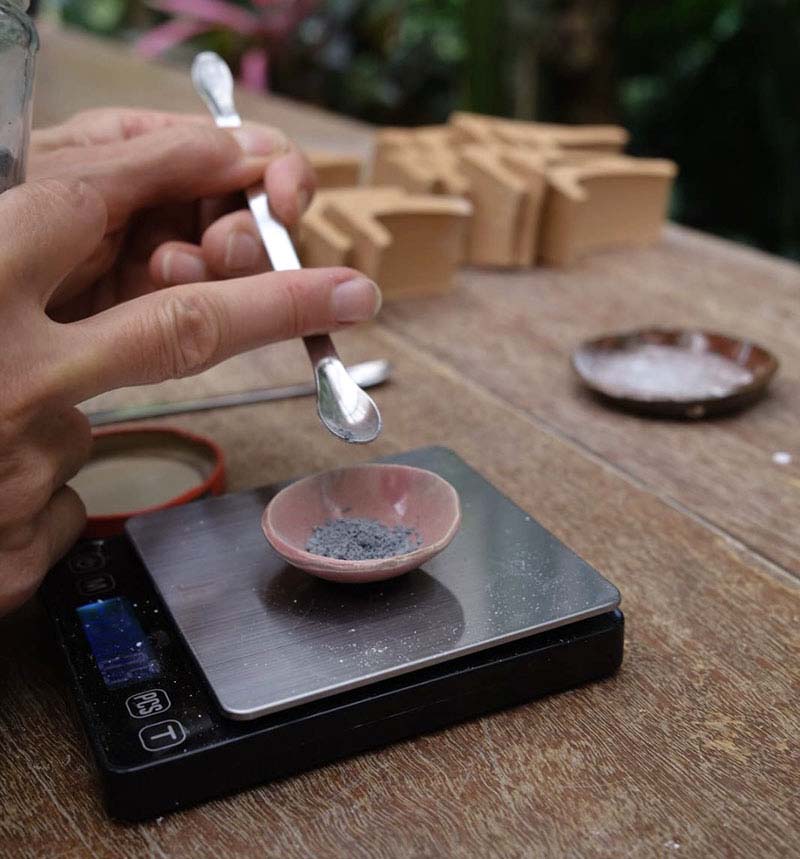
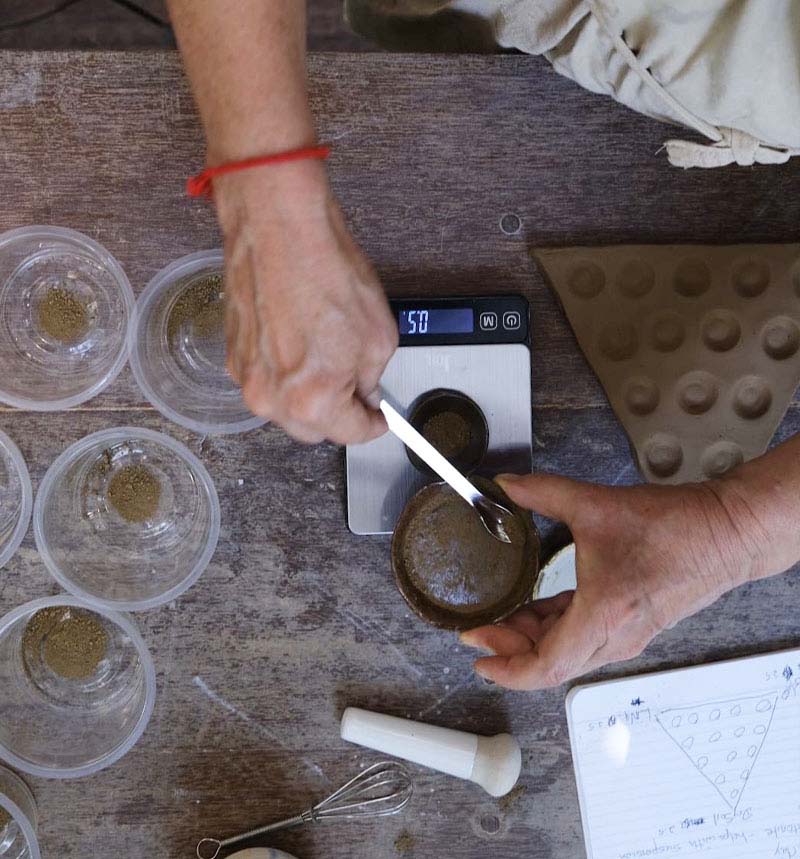
Ironically, the kiln itself is extremely low-tech. Mine is an old manual kiln: I press the button, wait for it to shut off, and unload it. Wild textures and interesting results don’t require a programmable firing schedule. The sophisticated part of the process is not the machine. It is the chemical model, the experimental design, and the analysis of what comes out of the kiln. And one of the things that model is trying to predict is viscosity.
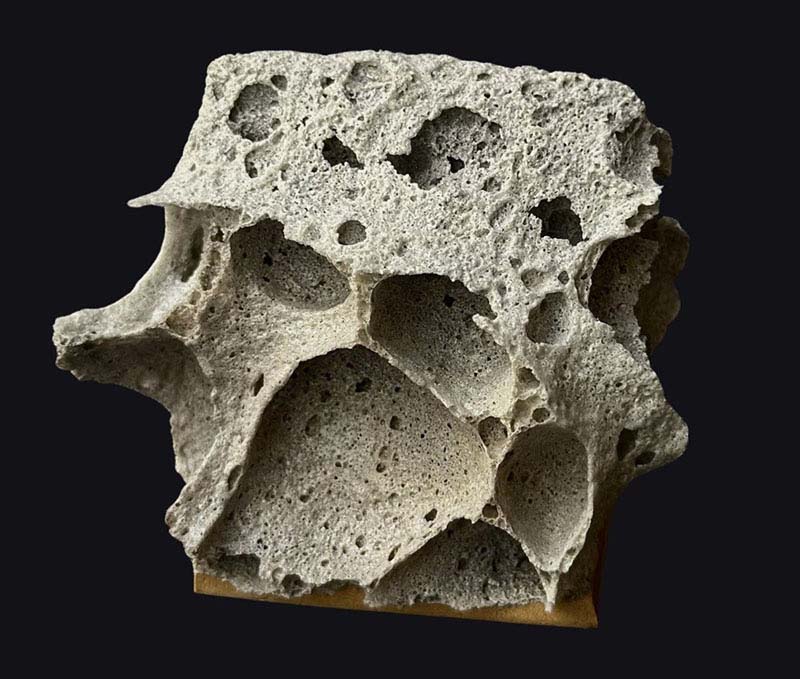
Viscosity is a fluid’s resistance to flow. Water has low viscosity, oil has more, and honey has even more. In a glaze, melting and viscosity are related, but they are not the same thing. Melting is whether the glaze becomes a liquid; viscosity is how stiff or fluid that liquid is. With regular flat glazes, especially stable functional glazes, melt viscosity can be surprisingly hard to see. Silicon carbide makes it visible. For a crater to form, a few things have to happen in the right order. Gas has to be generated after the glaze has begun to melt, so that there is actually a melt to trap it. Then that gas has to travel through the liquid glaze. If the melt is too stiff, the bubbles struggle to move through it. If it is too fluid, the bubbles can open, but the glaze flows back over them, and the surface heals. Somewhere in between is the zone where the gas can push through the melt, open the surface, and leave a crater behind before the glaze has time to flatten again.
This is one of the reasons I love silicon carbide glazes so much: they make something normally invisible suddenly visible. You can actually see how the melt behaves.
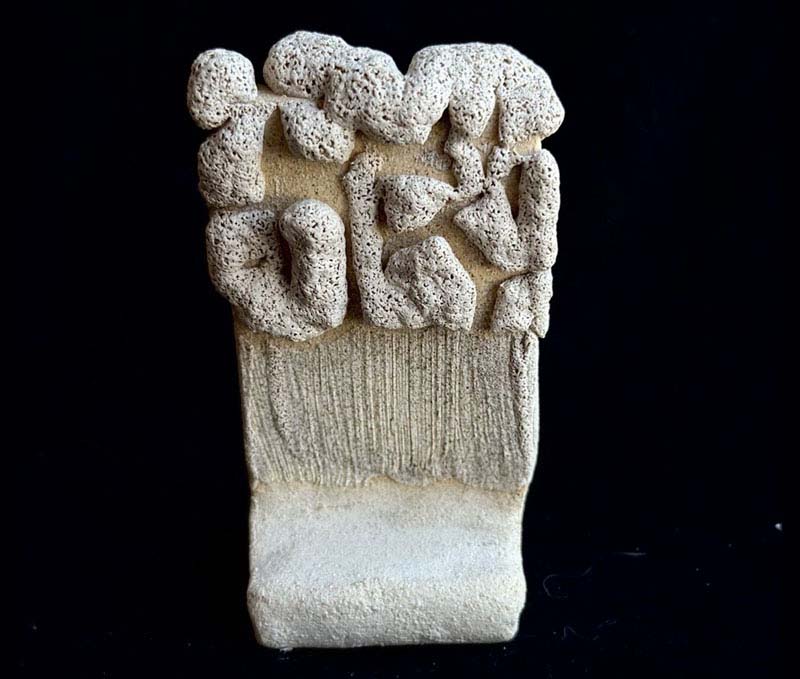
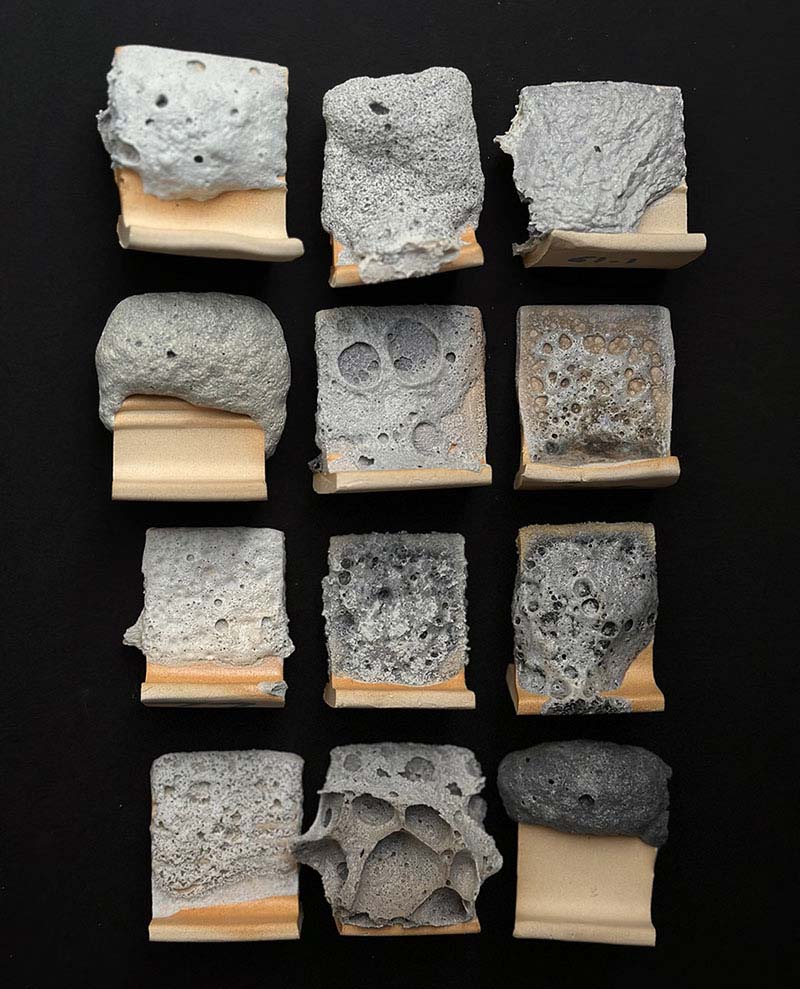
One experiment I like to use as an example is changing the R₂O-to-RO flux ratio while trying to keep everything else as consistent as possible. R₂O refers mainly to the alkali fluxes (sodium, potassium, and lithium), which are generally very active at cone 6. RO includes divalent fluxes such as calcium, magnesium, strontium, barium, and zinc, supplied by materials like whiting, magnesium carbonate, strontium carbonate, barium carbonate, zinc oxide, and dolomite. These fluxes behave very differently: sodium and potassium are generally stronger melters, while magnesium, for example, tends to produce a stiffer melt. Silica, alumina, silicon carbide, titanium dioxide, application thickness, and firing conditions remain the same. What changes is the balance between the alkali and divalent fluxes.
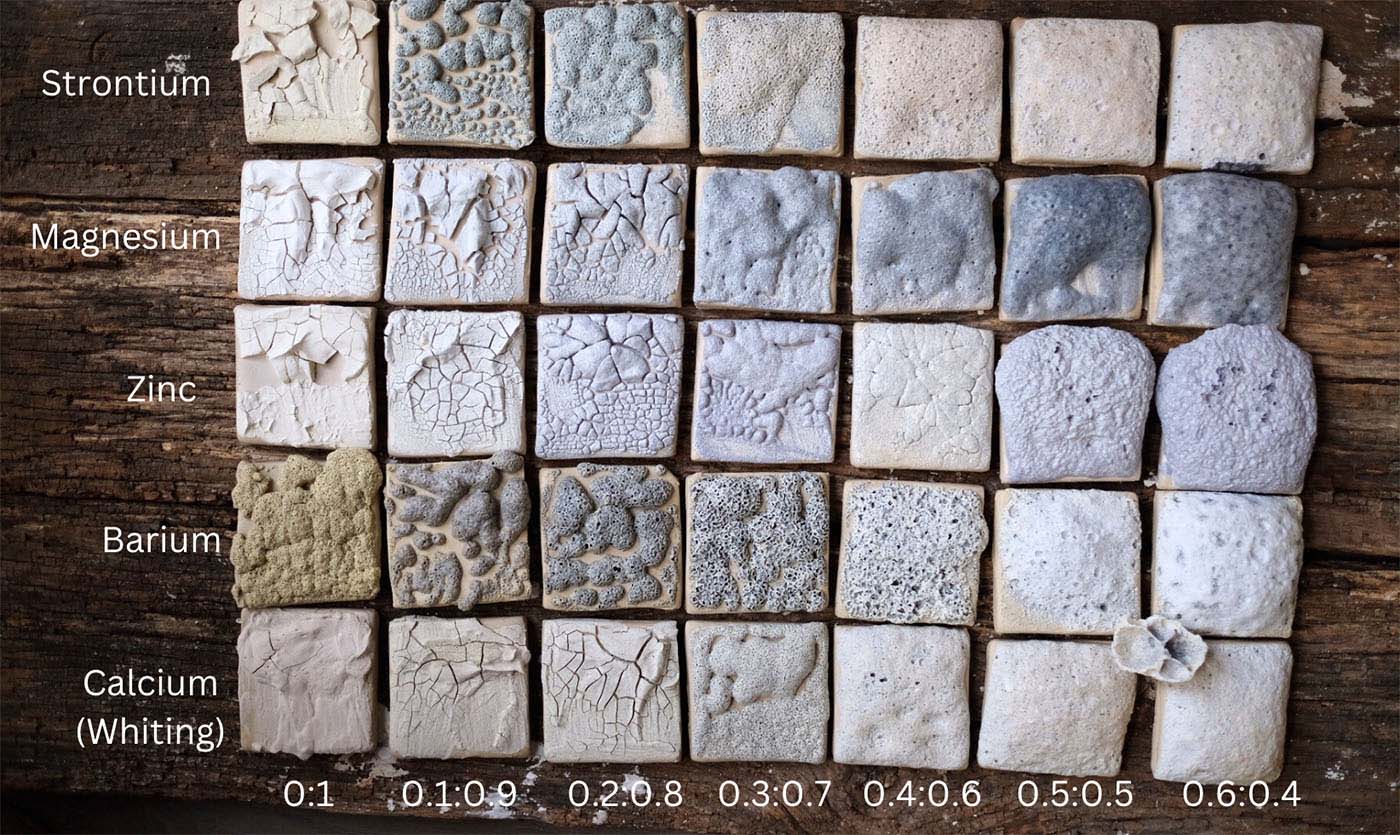
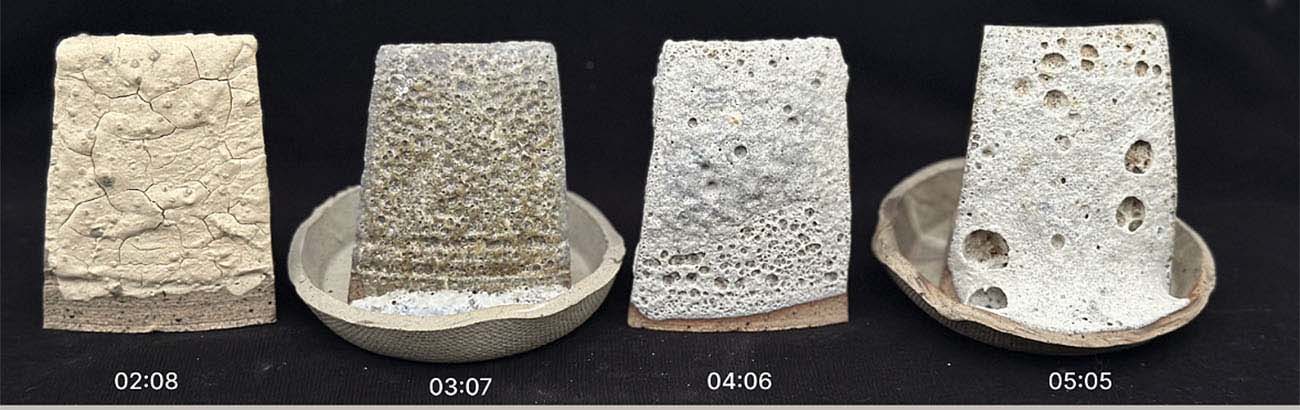
What makes this experiment especially interesting is that the ratio affects both how well the glaze melts and how fluid that melt becomes. As the ratio changes, the glaze moves through an entire range of behavior: from barely melting, to crawling and cracking, to opening into craters, to puffing dramatically, and eventually to becoming much more fluid and fragile.
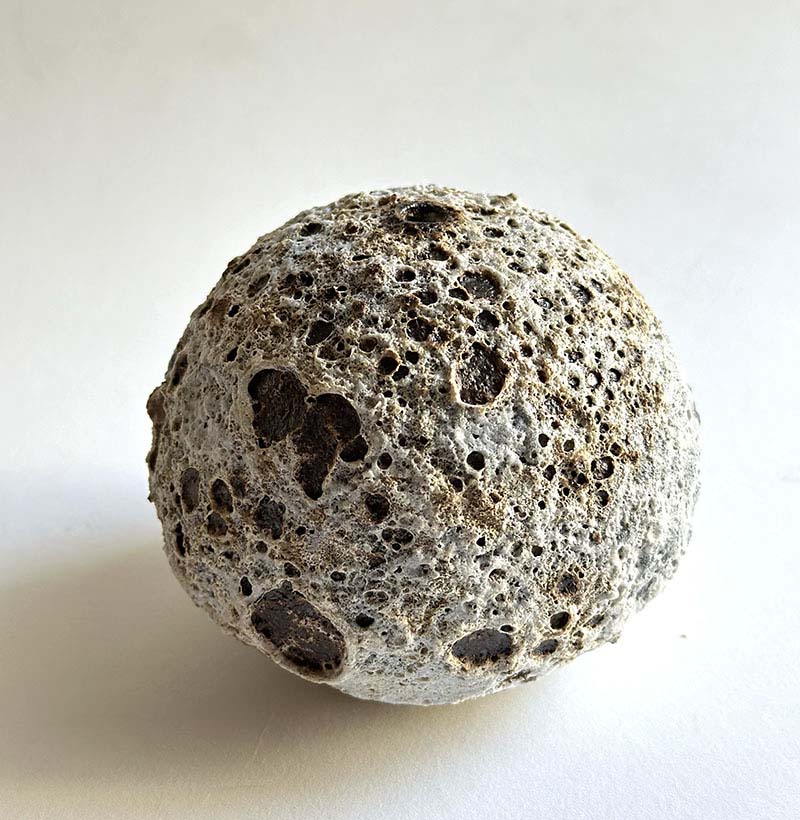
At the low-R₂O end, there is not enough strong fluxing action at cone 6 for the glaze to melt properly. The material barely becomes a glaze at all and can simply flake off the tile. Gas may still be generated, but there is not enough melt to trap it. As the amount of R₂O increases, the glaze begins to melt, crawling gradually disappears, bubbles become more visible, and the surface starts to open.
Further along, the problem changes. The glaze now melts perfectly well, but the melt becomes increasingly fluid. You get more bubbles and more dramatic puffing, but eventually every gain in bubbles starts to cost something: the surface becomes fragile and crumbly and can begin to collapse. So one variable takes the glaze through two different limits. At first, the question is: will it melt enough? Later, it becomes: once it is molten, is it stiff enough to hold the surface?
Interestingly, the best-behaving middle range also overlaps with ratios we often associate with more stable functional glazes. To me, that is another reminder that lava glaze chemistry is not some completely separate or exotic system. It simply makes ordinary glaze behavior much louder, offering a picture of what normally happens unseen inside the kiln. You change the chemistry, fire the tests, and suddenly you can see the melt behave in three dimensions. That is what I love most about lava glazes: they turn glaze chemistry into something you can actually see and touch.
A number of contemporary ceramic artists have expanded my sense of what highly textured surfaces can be, including Jay Kvapil, Paul Wearing, Brian Rochefort, Alex Zablocki, and Masaomi Yasunaga. Behind them stands a much longer historical line, including artists such as James Lovera and Lucie Rie. I am especially indebted to Aura May. Her coral-like surfaces and her way of layering lava glazes with other glazes were a huge inspiration when I first started experimenting. If I hadn’t encountered her work, I probably wouldn’t have gone as far into this research.
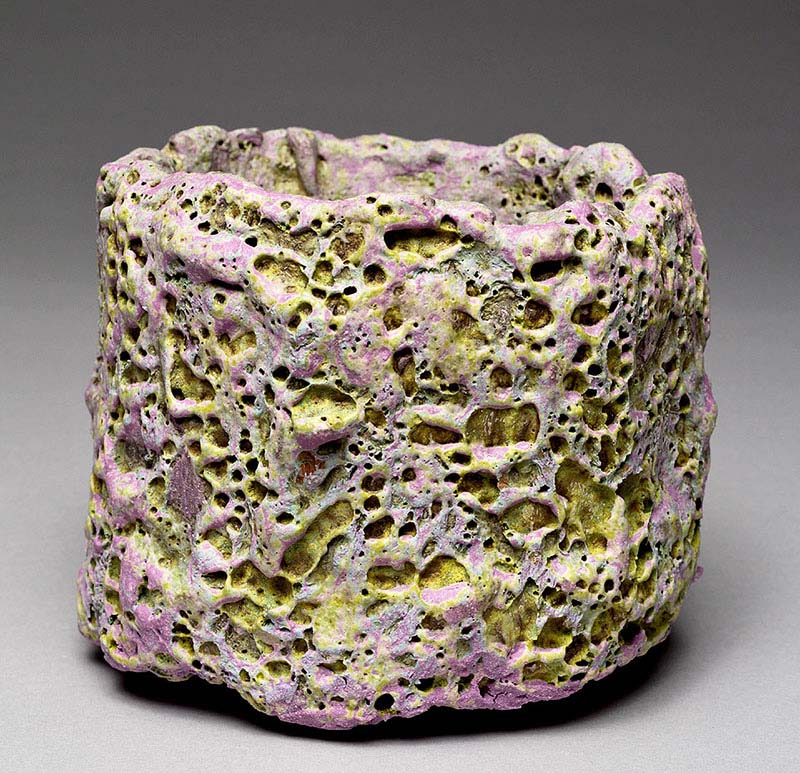
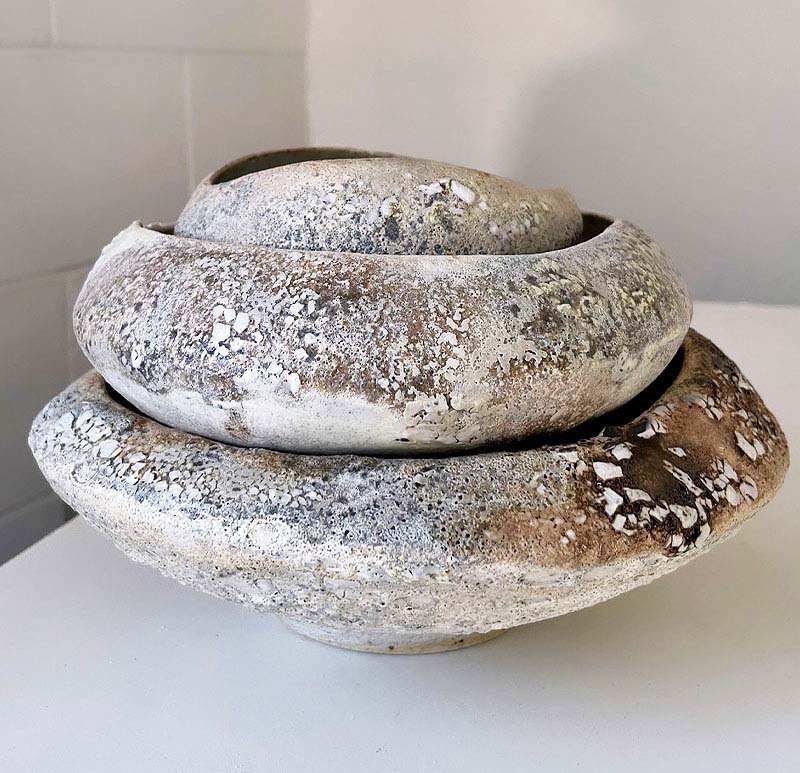
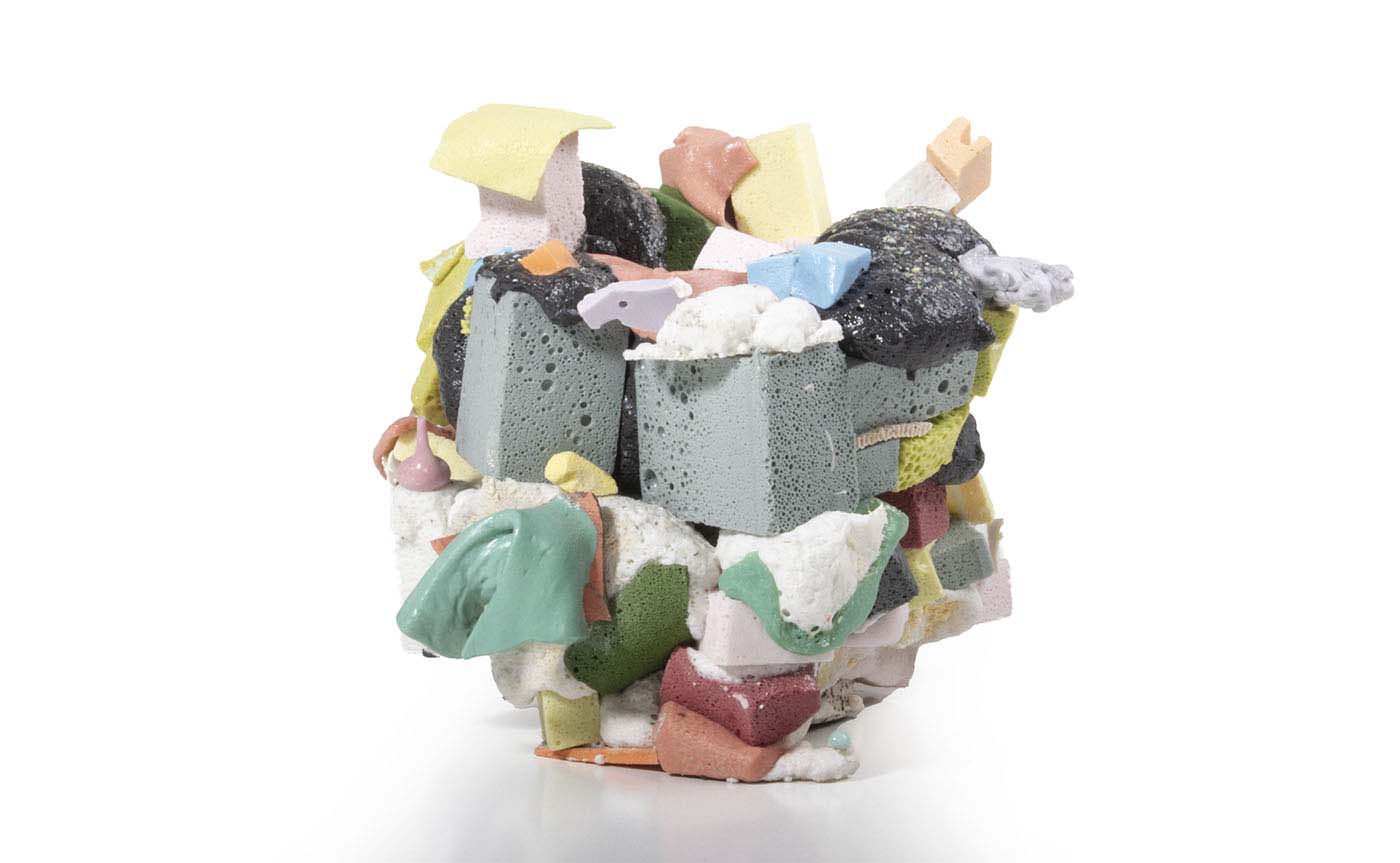
There is far more I want to test, especially at lower temperatures: other gas-releasing materials, different flux systems, firing conditions, and an almost infinite number of combinations that have not been explored. For me, the goal is not to eliminate unpredictability. It is to understand enough of the system that unpredictability becomes something I can work with. Then, in the final piece, I can give some of that control back to the materials and the kiln.
For those interested in exploring this research further, I teach two online courses. The Glaze Is Lava focuses specifically on silicon carbide–based glazes, including glaze chemistry, testing methods, variables, and the development of crater and lava surfaces. Textures in Ceramics takes a broader approach to ceramic texture, covering both unglazed surfaces and textured slips and glazes. I also share ongoing glaze tests, recipes, and research through my Patreon, along with shorter experiments, demonstrations, and process videos on YouTube. From time to time, I teach in-person ceramic intensives focused on texture, glaze testing, and experimental surface development.
Maria Loram is a California-based ceramic artist and educator whose minimal forms and organic, richly textured surfaces connect people to the cosmic unknown. Loram comes from a background in science, linguistics, yoga, and visual art. Treating glaze as a language of its own, she builds complex volcanic surfaces through extensive glaze research. She has exhibited internationally, participated in numerous residencies, and received several awards. Loram also leads workshops and online courses on texture and glaze development.

Maria Loram's Website & Shop
Maria Loram's YouTube